BIG FOOT FOOD FOREST
  • Home
  • Big Foot Letters
    • Newbie Farmer
    • Trees, shrubs, crops
    • Chicken Letters
    • Building
    • Mushrooms
    • Heritage sheep
    • Instructionals
    • 2026
    • 2025
    • 2024
    • 2023
    • 2022
    • 2021
    • 2020
    • 2019
    • 2018
    • 2017
  • Shop
    • Lambs for sale
    • Rainbow Egg CSA
    • Mushroom CSA
    • Food Scrap Exchange
    • Straw Bale House Workshop >
      • Register for Workshop
    • About >
      • What we do
      • Who We Are
      • Our Local Partners
      • Past newsletters
      • Contact
  • Visit
    • Community work days

2022

The Straw Bale Studio - timber frame gets built

4/13/2022

 
Picture
Before you put up a single straw bale, there is, well, a bit of work to do.   It turns out a straw bale building is not just a pile of straw with some plaster thrown on it.  It requires a foundation, to give the building sound footing and keep the straw dry. It needs a good roof that will not leak and will preferably have some decent insulation properties.   And on our case, it will have a timber frame structure to hold up the roof.  Before the workshop and the straw bale piling starts, we need to have all those things finished: the foundation, the timber frame, and the roof at least enclosed. ​ Here is how we built ours.
In February 2022, we drew a deep breath and ordered 53 enormous pieces of rough sawn timber.  Mark downloaded plans for a small timber frame, and we acquired one more set of tools: chisels, sharpening stones, and special Japanese saws (ryoba and miter).  Each weekend in March and April, we spent two good working days on the frame.   It is a lot, but we liked working quietly next to each other on a joint project.  Every now and then we’d have a brief exchange on how to do this or that, or to move another large piece of wood together.  I changed the music hourly, and Mark was patient about it.  It is a slow, steady progress with a lot of repetition.  Draw lines on beam very carefully and precisely.  Saw tenon out.  Chisel to precise thickness.  Use mortice saw for a mortice, use chisel for precise width.  Next tenon, mortice, beam.
Picture
Here is the saw list for our 53 timbers: Six timbers would become post beams and 3 would be the tie beams, each connecting two posts to make a bent – a three-sided rectangle (no bottom) going cross-sectionally over the width of the building. Two of the timbers would become plates which connect the bents at the eaves, and one timber would be a ridge beam, going across the length of the building at the roof ridge. These were the largest pieces. Then there were going to be 18 braces – diagonal pieces to keep timbers at 90-degree angles. Then five girts, connecting the posts at about 3 feet high; three king posts to hold up the ridge beam, and 20 rafters. 

The timbers were delivered onto our front “lawn” (the open space between the parking area and the house). We had to move them to a more sheltered spot, so Mark and I decided on the order in which we would cut the timbers and planned our timber pile so that we could work from the top down. Drew (one of our winter livestock caretakers) and I moved them one by one. Many of the timbers we could lift together and carry – with some oomph. But for the heavier ones – some weighed over 200 lbs – our newly acquired cart was indispensable. We would take the end of a beam, lift it onto the cart, then the other end, and then wheel it over to the pile. Making the timber pile was a good afternoon’s work. Another preparation was to set up a hoop house right in front of the build site, where we could work and store straw and other materials during the build. Finally, we made two super-sturdy sawhorses out of 2x4s. 

From March 12 onwards, Mark and I started spending one or two good working days most weekend
s cutting the frame (some days we took off to spend with our daughters or other activities). We worked like this through May 1.  Mark would draw the lines on each beam very carefully, so that we would know exactly where to cut. He used methods from his Learn to Timber Frame book (Beemer). Buying this book was well worth the money! The book had a precise description of each of the pieces of the frame, including: how to find the right face of the beams to cut the tenons and mortices into; exactly where the tenons and mortices would go; exactly what the shape of each tenon and mortice was. One might think it was a matter of just “following the directions” and drawing where to make cuts just exactly according to what was written in the document, but it was not quite that simple. Whenever we started on a new type of beam (the posts, the braces, the crossbeams,  etc.) Mark would take a good little while to think about what the document said and exactly how to translate that onto the wood in the form of the thin penciled lines that were our guides for cutting.  Although the wood pieces we were working with were huge, the cuts had to be precise down to an eighth of an inch or less; otherwise, the pieces would not fit together in the end. So, when you do this at home, draw those lines very carefully!
 
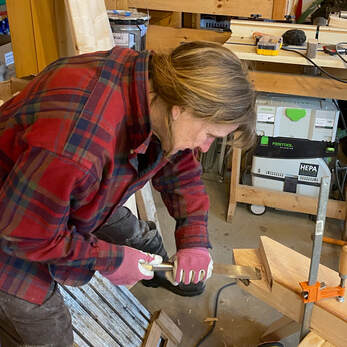
When drawing the lines was done, we could start to cut. We had to figure out how to use the ryoba saw (some YouTube videos) and the chisels (more YouTube videos). From there, it is very meditative and repetitive.  Saw a tenon out. Chisel to the precise thickness. Use mortice saw for a mortice, use chisel for precise width. Next tenon, mortice, beam.
 
One trick that Mark hit on was to build guides, or jigs. For example, the tenons had to be exactly 1 1/2 inches thick, so he built a little frame, with an interior opening of exactly 1 1/2 inches by about 8 inches. To see if the tenon was just right, we’d slip the frame over it. When it could go over all the way, with just a hair of wiggle, the tenon was right. 
 
We finished the 18 braces in the first weekend. Our next set of timbers were the posts. Mark figured out the drawing on Saturday morning, March 19, and when he had drawn the first piece, I got started with sawing and chiseling. We finished five of the six posts in the second weekend. The third weekend, we did the sixth post, plus the five girts, each weekend starting with Mark drawing and then both of us working. And so forth. It went along steadily. 
 
Mid-May we oiled the pieces and moved everything to the hoop house that we had built right next to the build site as a temporary storage area. It was oh so satisfying to see these large pieces of wood with their elegant puzzle cut-outs. They were (and are) beautiful. Once we finished all the pieces, we test-assembled some of the parts and drilled holes for the pegs that pull everything together tightly. We crossed our fingers that everything would fit!!!!  
 
Some thoughts on tools we purchased, and tools Mark made. The purchased tools for cutting a timber frame are exquisite – and specialized. Most are incredibly simple and elegant and are just the right tool for the job. Unfortunately, if you have not timber framed before, you are likely to have to purchase the whole set. You will need:
 
A ryoba saw. This is a Japanese saw with a very thin, flexible two-sided blade (one for cutting on the wood grain, the other for across). To cut, you pull on the saw. I have never worked with a more pleasurable hand saw.
 
Very good chisels, 1” and 1.5” wide. We got one Japanese one with a wooden handle and a rather thick blade, which was hands-down the better one; we had two other ones with metal handles, which did the job well enough but were much more tiring to work with.  Sharpen them well!  Babette received an awesome chisel sharpening lesson from her old friend and boss George Ingram.  George uses the chisels for making fine furniture (when he’s not writing policy papers at Brookings).

 An excellent mallet. We purchased a Wood is Good mallet, which, as the reviews say, is an awesome tool. We had another lesser quality mallet, and it was painful to use compared to the Wood is Good.
 
A sharpening stone. The chisels need to be ultra-sharp to work well, and we gave ours a quick little sharpening each day before we started.
Measuring tools—most notably the carpenter’s square. I believe this was the tool that practically never left Mark’s hands. Of course, also a good tape measure. Duh.
 
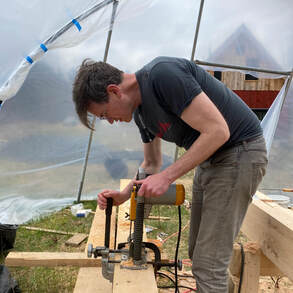
A chain morticer. This specialized power saw rough cuts the mortices. It saved us no end of time. Mark would mark out all the mortices on an entire beam (on any given side, they are all in a line with each other) set the chain morticer to whatever the standard distance was from the edge of the beam and vrmm, vrmm, vrmm, would get a rough cut for all the holes on one side of a beam. Awesome! Cool detail: Mark ordered his used one all the way from Japan!
 
Finally, jigs are your best friends. Mark made about eight different jigs out of left-over pieces of oak flooring and bits of better-quality plywood scraps. There was the one to get the width of the tenons exactly 1.5”; a couple to get the shapes of the dove tail tenon and mortices just right; one for the plates, to get the distance between the mortices for the posts and those for the braces exact; and a number of jigs to know where to drill the holes for the pegs (the holes have to be extremely exact in order to allow a peg to go through a hole in a beam exactly to the hole in the tenon). The jigs all take a little while to make because they need to be super-precise, but then they save lots of time while improving the outcome of your product. We totally recommend making a jig for just about any of the timber frame cuts! 
Picture
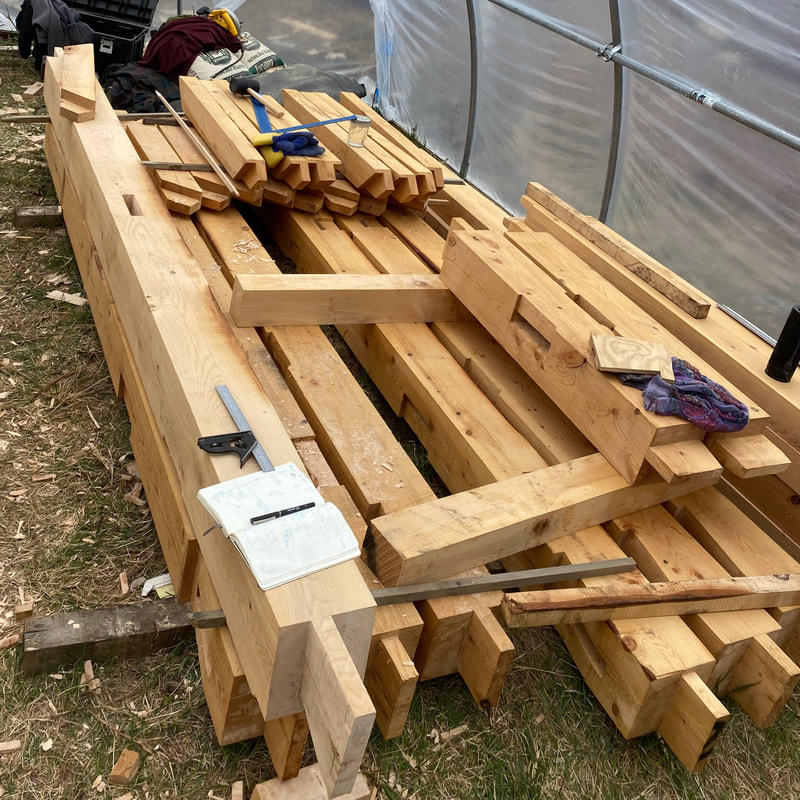
Here is a photo of all the timber frame pieces, oiled, and lying in the hoop house (minus one last good burst of weekend work for the rafters).   It was oh so satisfying to see these large pieces of wood with their elegant puzzle cut-outs.  They were beautiful.   Once all the pieces were finished, we test-assembled some of the parts and drilled holes for the pegs that would pull everything together tightly.  Cross our fingers everything fits!!!!  Then we were be ready for ….
 
Timber-frame Raising Day!    May 22 (rain date May 29)!
 
In the meantime I also started work on the foundation with two hard-working and cool Workaway guests, Paul and Hermine from Europe.  They have a permaculture project similar to ours going on in Central Spain and want to build a straw bale house. More on that in a next blog post!​

Comments are closed.
Proudly powered by Weebly
  • Home
  • Big Foot Letters
    • Newbie Farmer
    • Trees, shrubs, crops
    • Chicken Letters
    • Building
    • Mushrooms
    • Heritage sheep
    • Instructionals
    • 2026
    • 2025
    • 2024
    • 2023
    • 2022
    • 2021
    • 2020
    • 2019
    • 2018
    • 2017
  • Shop
    • Lambs for sale
    • Rainbow Egg CSA
    • Mushroom CSA
    • Food Scrap Exchange
    • Straw Bale House Workshop >
      • Register for Workshop
    • About >
      • What we do
      • Who We Are
      • Our Local Partners
      • Past newsletters
      • Contact
  • Visit
    • Community work days